- We are open every : MON - SUN : 6:00AM - 7:00 PM
- balidriverandtour12@gmail.com
A solo trip to Bali can be surprisingly easy to organize because the island offers a wide range of accommodation, restaurants, activities, beaches, cultural sites, and transportation options. The bigger challenge is deciding where to stay and how to move between areas without spending too much time in traffic.
Bali is not one compact destination. Ubud, Seminyak, Canggu, Sanur, Uluwatu, East Bali, and North Bali each offer a different experience. For a solo traveler, choosing the right base can make a bigger difference than trying to visit as many attractions as possible.
If this is your first visit, a practical approach is to combine one walkable area, one cultural destination, and one or two day trips rather than changing hotels every night.
Yes, Bali can work very well for solo travelers, particularly if you enjoy having flexibility in your schedule.
You can spend a morning exploring a temple, have lunch at a local warung, visit a rice terrace in the afternoon, and return to your hotel before dinner. You also have plenty of opportunities to join activities such as cooking classes, yoga, surfing, cycling, diving, rafting, or day tours.
Bali also has established tourist areas where it is relatively straightforward to find accommodation, restaurants, cafés, transportation, and activities.
However, solo travel in Bali still requires normal travel awareness. Traffic can be heavy, roads can be narrow, and some attractions are separated by considerable driving distances. Indonesia’s official tourism guidance also advises visitors to respect local customs, follow traffic regulations, and be patient with congestion and ceremonial processions.
Your best location depends on what you want from the trip.
Ubud is a practical base if your priority is Balinese culture, rice terraces, temples, wellness, art, and inland scenery.
You can explore the town on foot in some areas, while attractions outside central Ubud are better reached by car or organized transport.
Popular places around Ubud include:
Ubud Palace
Saraswati Temple
Ubud Art Market
Tegallalang Rice Terrace
Tirta Empul
Goa Gajah
Campuhan Ridge Walk
Monkey Forest Ubud
Monkey Forest Ubud currently lists opening hours of 9:00 AM–6:00 PM, with last entrance at 5:00 PM. Its official site also lists adult admission at IDR 130,000 and child admission at IDR 100,000, although travelers should check the attraction’s current information before visiting.
Sanur is worth considering if you want a quieter beach atmosphere and relatively easy access to South Bali.
It is also convenient for travelers planning a trip to Nusa Penida or Nusa Lembongan, as boat services commonly operate from the Sanur area.
The beach promenade is useful for walking or cycling, and the sunrise is one of the area’s highlights.
Seminyak suits solo travelers who want more restaurants, cafés, shops, beach clubs, and evening activity.
It is a convenient base for exploring nearby areas such as Legian, Kuta, Canggu, and Tanah Lot, although traffic can make short distances take much longer than expected.
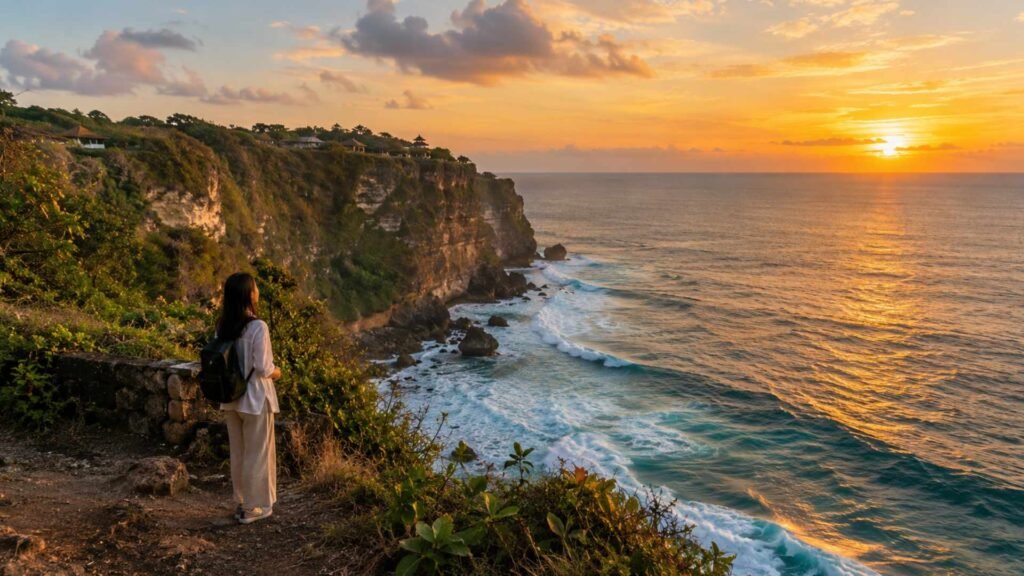
Uluwatu is a strong choice if your priority is dramatic coastal scenery, beaches, surfing, and sunsets.
The area is more spread out than central Ubud or Seminyak, so having reliable transportation becomes more important.
Transportation is one of the most important decisions during a solo trip to Bali.
A scooter can be convenient for experienced riders, particularly around smaller local roads.
However, Bali traffic is not something to underestimate. Roads can become busy around tourist centers, and unfamiliar intersections, ceremonies, narrow village roads, rain, and uneven surfaces can make riding more demanding.
Foreign visitors are expected to follow Indonesian traffic laws and use roadworthy, properly operated transportation.
If you are not already comfortable riding a scooter in busy Asian traffic, do not make Bali your place to learn.
Ride-hailing and taxis are useful for short journeys, especially around the main tourist areas.
They become less convenient when you want to spend an entire day visiting several attractions because you may need to arrange multiple rides and wait between destinations.
For a solo traveler visiting several parts of Bali in one day, a private car with a driver can simplify the trip considerably.
A local driver can handle navigation, parking, changing routes, and traffic conditions while you concentrate on the experience. This is particularly useful for routes such as Ubud–Kintamani, Ubud–East Bali, South Bali–Tanah Lot, or Uluwatu–Jimbaran.
Indonesia’s official tourism information specifically notes that visitors can hire a car and driver and arrange a desired route.
From a local driving perspective, the biggest advantage is not simply comfort. It is time. A route that looks short on Google Maps can take considerably longer when traffic, ceremonies, road conditions, and parking are involved.
You do not need to cross the entire island every day. A balanced itinerary is easier and leaves room for spontaneous discoveries.
Use your first day to check into your accommodation and explore the immediate neighborhood.
If you arrive at Ngurah Rai International Airport, allow extra time for immigration, luggage, airport pickup, and traffic. The airport is located in the southern part of Bali near Kuta and Tuban.
Avoid planning a complicated sightseeing route immediately after a long international flight.
Start with central Ubud and continue toward one or two attractions outside town.
A possible route is:
Ubud Palace → Saraswati Temple → local lunch → Goa Gajah → rice terrace → Ubud
Do not try to fit every Ubud attraction into one day. Traffic and walking time add up quickly.
Choose one main activity rather than filling the day with attractions.
Options include:
Rice terrace walk
Balinese cooking class
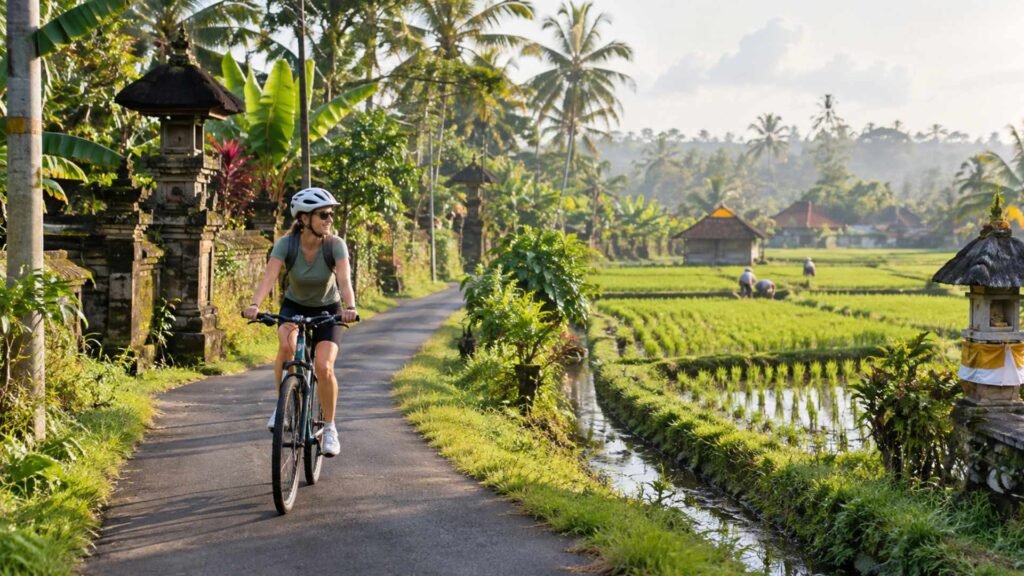
Cycling
Traditional craft workshop
Ayung River rafting
Waterfall visit
Wellness or spa experience
This gives you time to interact with local businesses rather than simply collecting photographs.
For a change of scenery, consider a day trip toward Kintamani and the northern highlands.
An early departure is useful because mountain roads can become busy later in the morning.
Mount Batur and Lake Batur are among Bali’s best-known highland landscapes, while cycling and outdoor activities around Ubud are also highlighted by Indonesia’s official tourism information.
If you want a different atmosphere, move to Sanur, Seminyak, or another coastal base.
Use the afternoon for a beach walk, café stop, massage, or relaxed dinner rather than scheduling another full sightseeing route.
Choose either Uluwatu or another southern coastal route.
A typical day could include:
Padang-Padang Beach → Uluwatu area → sunset → Jimbaran
Keep the schedule flexible. Sunset locations can become crowded, and coastal roads can slow significantly during busy periods.
Keep your final day simple.
Have breakfast near your accommodation, buy souvenirs, and leave enough time for the airport transfer.
If your flight is international, do not calculate airport arrival time based only on the driving time shown by a navigation app.
Your budget depends heavily on accommodation, activities, restaurants, and transportation.
A backpacker staying in simple accommodation and eating mainly at local warungs can spend considerably less than a traveler staying at a boutique hotel and joining several paid activities.
Your largest daily expenses are usually:
Accommodation
Transportation
Food and drinks
Activities
Entrance fees
Shopping
Airport transfers
One advantage of traveling alone is that you can control the budget very closely. You do not need to choose restaurants or activities based on a group.
For attractions, always check current official prices before visiting because entrance fees and operating arrangements can change.

Bali can be visited throughout the year, but weather affects outdoor activities.
The drier months are generally more comfortable for beaches, hiking, sightseeing, and photography. The wetter period can still be enjoyable, but rain may arrive suddenly and affect outdoor plans.
A useful local strategy is to keep flexible activities on rainy days.
For example:
Rainy morning: café, museum, cooking class, spa, or shopping.
Clear afternoon: temple, rice terrace, beach, or viewpoint.
Do not assume that rain means the entire day will be unusable. Tropical showers can be heavy but relatively short.
Temples are an important part of everyday Balinese life, not simply tourist attractions.
Dress respectfully when visiting sacred places. In general, shoulders and knees should be covered, and a sarong and sash may be required.
Do not enter restricted areas, climb sacred structures, interrupt ceremonies, or photograph people during religious activities without consideration.
Bali’s published guidance for foreign visitors emphasizes respecting sacred places, local customs, religious ceremonies, appropriate clothing, and polite behavior.
If you encounter a religious procession on the road, expect traffic to stop or move slowly. This is part of traveling in Bali rather than an unusual traffic problem.
Early departures are particularly useful for major temples, mountain destinations, waterfalls, and popular photography locations.
You will usually have a more comfortable experience before the heat and crowds build up.
Avoid planning:
Uluwatu → Ubud → North Bali → Seminyak
in one day.
Bali may look small on a map, but road travel can be slow. Build your itinerary geographically.
Cards and digital payments are widely used in tourist areas, but small businesses and local warungs may still prefer cash.
Keep your phone charged and carry a power bank if you are spending a full day outside your hotel.
At Monkey Forest and other areas where monkeys are present, do not treat them like domestic animals.
The Monkey Forest’s own visitor guidance notes that its macaques live in a semi-wild environment and advises visitors to follow safety guidelines.
Keep food and loose belongings secure, and avoid provoking or touching the animals.
One of the best things about solo travel is flexibility.
You might discover a small coffee shop, a village ceremony, a beautiful rice-field view, or a local restaurant that was never on your itinerary.
Leave some empty space for those moments.
The most common mistake is trying to see too much.
Another is underestimating driving time. A 30-kilometer journey does not necessarily mean a 30-minute journey in Bali.
Other mistakes include:
Changing hotels too frequently
Booking attractions without checking current conditions
Forgetting temple dress requirements
Planning outdoor activities without considering rain
Riding a scooter without sufficient experience
Scheduling a distant attraction immediately before a flight
Spending the entire trip inside tourist-heavy areas
Ignoring local ceremonies and road closures
A slower itinerary often gives you a better understanding of Bali than an itinerary packed with ten attractions a day.
It depends on your itinerary.
If you are staying in one area and mostly walking, using taxis or ride-hailing can be enough.
If you want to explore several destinations in one day, a private driver can be practical even for one person. You have a dedicated vehicle, do not need to negotiate separate rides throughout the day, and can adjust the route when weather or traffic changes.
For example, a Bali Day Tour from Ubud can combine a temple, waterfall, rice terrace, and local restaurant without requiring you to arrange separate transportation between every stop.
For East Bali or North Bali, where attractions are more spread out, having a driver can also make the day easier to manage.
The key is to choose the transportation style that matches your route rather than automatically choosing the cheapest option.
A solo trip to Bali does not need to be complicated. Choose one or two good bases, plan attractions by geographical area, leave room for weather and traffic, and treat Bali as a living destination rather than a checklist of Instagram locations.
Ubud is useful for culture and inland experiences, Sanur offers a calmer coastal base, Seminyak provides restaurants and nightlife, and Uluwatu delivers dramatic southern scenery. From any of these areas, you can add carefully planned day trips to discover more of the island.
Travel slowly, respect Balinese customs, and allow your itinerary to change when local conditions call for it. That flexibility is one of the biggest advantages of traveling alone in Bali.
Bali is a popular destination for independent travelers, but solo visitors should use normal precautions, follow local laws, take care around traffic, and respect local customs and religious sites.
Seven days is a practical starting point for a first visit. It allows time for Ubud, a coastal area, and one or two day trips without constantly changing hotels.
Bali can fit different budgets. Accommodation, transportation, food, and activities can range from relatively simple options to high-end experiences, so your daily spending depends heavily on your travel style.
Choose Ubud if you prioritize culture, nature, wellness, and inland attractions. Seminyak is more suitable if you prefer restaurants, cafés, shopping, beaches, and evening activity.
Yes. Taxis, ride-hailing services, organized tours, and private drivers provide alternatives. For longer sightseeing routes, a private driver can be particularly convenient.
It can be, especially for a full-day itinerary covering several attractions. The value comes from having flexible transportation and avoiding multiple separate rides rather than from splitting the cost among a group.
Wear modest clothing that covers the shoulders and knees. Some temples require a sarong and sash. Always follow the specific rules displayed at the temple.
There is no single perfect month for every traveler. Generally drier weather is more convenient for outdoor sightseeing, while the wetter season can still work if you keep your itinerary flexible.
Try to group attractions that are close together. Bali traffic can make seemingly short journeys much longer, particularly around South Bali and during busy periods.
Yes. Many attractions, restaurants, cafés, beaches, temples, and activities can be enjoyed independently. For remote areas or complicated day-trip routes, organized transportation can make the experience easier.

After sending email information to us, we will contact you as soon as possible via email sent directly





balidriverandtour12@gmail.com
+62 812 378 153 55

Bali Driver & Tour – 2024